If you’re in process manufacturing, chances are you’re still heavily reliant on Excel for planning. And for good reason: it’s flexible, familiar, and gets the job done – until it doesn’t.
The truth is, Excel isn’t the enemy. It’s often the perfect starting point. But there comes a moment when the complexity of your operations quietly outpaces what spreadsheets can handle. The real question isn’t if you’ll hit that ceiling, but when, and whether you’ll recognize it before it costs you.
The Excel Ceiling: When Good Enough Becomes Not Good Enough
Excel works brilliantly for localized, individual problems. It has zero implementation barriers and offers unmatched flexibility. But as your business scales, something shifts.
Suddenly, you’re not just managing one spreadsheet. You’re managing dozens, each serving a single purpose, none of them talking to each other. Manual reconciliation becomes routine. Copy-paste becomes a daily job. And the person who understands all the macros and hard-coded assumptions? They’re one resignation away from taking your entire planning capability with them.
This is what we call the Excel ceiling: the point where maintenance effort exceeds decision value, and confidence in your results begins to erode.
Five Failure Modes That Signal It’s Time to Evolve
In our work with our customers, we’ve identified five patterns that repeatedly emerge when Excel becomes a liability:
- Constraint Blind Spots
Capacity, materials, and sequencing constraints are handled separately, or worse, ignored entirely. What looks feasible in one sheet becomes impossible when you consider the full picture. Local optimization doesn’t guarantee global feasibility. - Fragile Logic
Hidden formulas, undocumented overrides and assumptions buried in cells create a house of cards. You have high confidence in the numbers but low confidence in the logic behind them. - Scenario Paralysis
When management asks, “What if tariffs increase by 10%, 15%, or 25%?” each scenario requires days or weeks to model. By the time you finish, the question has changed. Excel doesn’t just slow you down; it discourages scenario thinking altogether. - Shelf Life & Variability Risk
Expiry dates, yield variability and changeovers are handled heuristically. Waste and service failures appear “unexpected,” but they’re actually the result of planning tools that can’t accurately model reality. - Locally Right, Globally Wrong
One plant gets optimized at the expense of the network. One customer gets prioritized without understanding the downstream impact. Excel hides the economic consequences of these decisions.
Explore the 5 Patterns Infographic
Why Process Manufacturing Makes This Worse
Process manufacturing adds layers of complexity that spreadsheets simply weren’t designed to handle:
- Formulation changes trigger cascading impacts across materials, capacity and costs
- Sequence-dependent changeovers mean the order of production matters as much as the volume
- Multi-site coordination requires visibility across locations but Excel decisions are made with partial context
- Shelf-life tradeoffs force you to balance waste risk against service risk, and Excel treats both as equal delays
Consider this: mathematically, 1 unit late by 100 days looks identical to 100 units late by 1 day. But the business impact? Completely different. Excel can’t distinguish between them.
What Reality-First Planning Actually Looks Like
Reality-first planning isn’t about abandoning Excel. It’s about recognizing when your planning approach needs to reflect how operations actually behave, not just how spreadsheets assume they behave.
It’s built on three pillars:
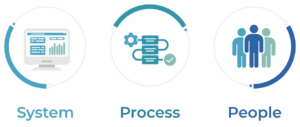
System: Constraint-aware, integrated across functions, and designed to handle uncertainty—not eliminate it.
Process: Clear ownership, defined decision cadence, and locked versus flexible horizons that are intentional, not accidental.
People: Shared understanding, cross-functional buy-in, and agreement on direction—not false precision.
The goal isn’t more precision. It’s better decisions under uncertainty. It’s being generally right instead of precisely wrong.
How to Tell If You’re Outgrowing Excel
You don’t need a crisis to justify change. You need awareness. Here are the practical signals:
- Spreadsheet maintenance is dominating your planning time
- Evaluating scenarios takes too long to be useful
- Decisions rely on heroic individual effort
- Confidence in your numbers is quietly declining
- Growth events (M&A, new geographies, expanded portfolios) expose fragility
If any of these sound familiar, you’re not alone. And you’re not behind. You’re simply at a point where the tools that got you here may not be the tools that get you where you need to go.
Join Us for a Deeper Dive
This blog only scratches the surface. In our upcoming webinar, Reality-First Planning: Why Excel Breaks Down in Process Manufacturing, we’ll walk through:
- Live scenario analysis showing how constraint-based thinking changes decisions
- Real-world examples from process manufacturing customers
- How to tell when you’ve hit the Excel ceiling—and what to do about it
- Common misconceptions about planning systems (and why many implementations fail)
This isn’t a product pitch. It’s a conversation about decision quality, organizational readiness, and how to know when it’s time to evolve your planning approach.

Register for the Webinar →
Better planning isn’t about buying software. It’s about recognizing when your current approach has quietly stopped serving you and having the clarity to do something about it.
About the Authors:

Sujit Singh
As COO of Arkieva, Sujit manages the day-to-day operations at Arkieva such as software implementations and customer relationships. He is a recognized subject matter expert in forecasting, S&OP, and inventory optimization. Sujit received a Bachelor of Technology degree in Civil Engineering from the Indian Institute of Technology, Kanpur, and an M.S. in Transportation Engineering from the University of Massachusetts. Throughout the day don’t be surprised if you find him practicing his cricket technique before a meeting.
Justin Evilsizor
Now in his thirteenth year at Arkieva, Justin provides technical demonstrations to prospective customers as the manager of the presales team. Before that, he spent many years designing and building KPIs (and once had the number one google image search result for ‘infographic resume’). Justin holds a master’s degree from the University of Pennsylvania and an undergraduate degree from DAAP. In addition to work, he is a recognized chess coach and mentor, and has served on the boards of several non-profits.